Anne Applebaum discusses autocracies, corruption with Carolina Diplomacy Fellows

This story was originally published on global.unc.edu.
Amid major global conflicts and challenges to democratic institutions around the world, Anne Applebaum came to Chapel Hill to discuss the role of disinformation and corruption in autocratic governments.
Applebaum is a Pulitzer Prize-winning author, historian and journalist. She currently is a contributing writer at The Atlantic. She visited UNC-Chapel Hill on Thursday, March 5, to speak in the final Diplomatic Discussion of the academic year. The event, called “Kleptocracy, Inc.: The Corrupt Networks That Maintain Modern Dictatorships,” centered on the rise of autocratic behaviors and misinformation campaigns in North America and Europe.
“In order to keep a democracy functioning, countries need not only partisan warfare, but also institutions that can last and can exist — whoever’s in power,” she said. “Dictatorships have understood that in order to maintain their power, one of the things they need to do is capture the civil service, capture those permanent institutions, politicize them and keep them in control.”

Protecting institutions from authoritarianism and democratic backsliding
According to Applebaum, kleptocracies are political systems inherently linked to the idea of corruption.
“It’s a system where the people who run the state are also the people who run the economy — and they’re able to use state power in order to enrich themselves,” she said.
Applebaum pushed back at the idea countries can be described as purely democratic or autocratic, instead suggesting governments can exhibit both democratic and autocratic behaviors. Because historically democratic systems are just as capable of falling victim to authoritarian practices, she warned, it is crucial that citizens stay vigilant in protecting democratic institutions.
“Preventing our country from heading in that direction is maybe the most important thing we can do in the next couple of years,” she said.
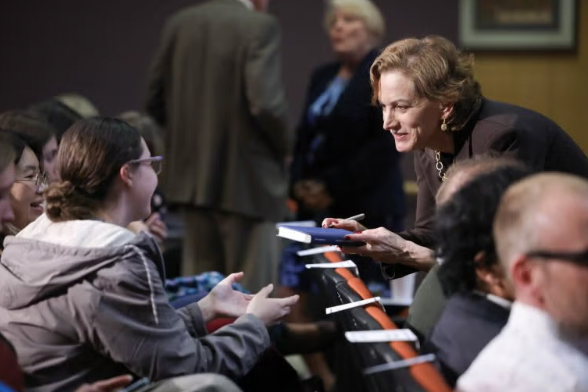
Leaders/Readers Circle
Before the Diplomatic Discussion, Applebaum met with students who had read her books, as well as students in Associate Professor Theodore Leinbaugh’s class in the UNC Curriculum in Peace, War and Defense. Small-group engagements with Diplomatic Discussion speakers remain a key part of the Diplomacy Initiative.
“It was so refreshing listening to someone talk about these difficult issues and just respectfully say it as it is,” said Transatlantic Masters student Katarina Trampush. “While I thought all of her points were spot on, I particularly liked how she discussed the transatlantic relationship. She portrayed both the American and European perspectives with such clarity, precision and conviction.”
Continuing to understand information warfare
Applebaum’s talk built on ideas discussed in September’s Diplomatic Discussion, “When Nothing Seems True: Information Warfare and the Fight for Democracy.” Jennifer Davis, Knott Distinguished Professor of Practice in the UNC Curriculum in Peace, War and Defense and Diplomacy Initiative Faculty Fellow, spoke at the event in September and moderated the fireside chat with Applebaum.
I was struck by the clarity of her call to democratic countries to understand that the threats to our institutions and information systems are real and existential,” Davis said. “She urged us to move past partisan polarization to adequately protect ourselves from foreign malign influence or risk witnessing the ‘twilight of democracy.’”
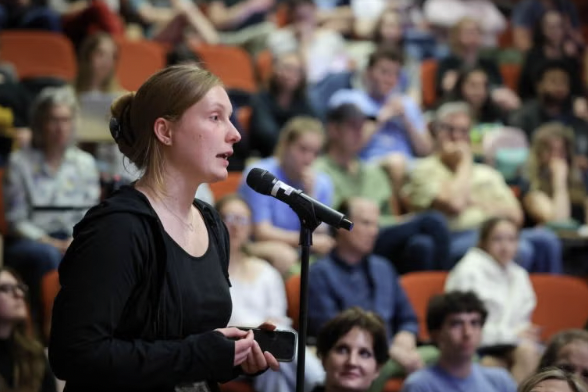
When asked how ordinary citizens could play a part in protecting democratic norms, Applebaum encouraged the audience to attempt constructive conversations with others offline and to consider how they could bring their own individual talents to local efforts.
“If you’re a lawyer or a law student, you can be involved with one of the many organizations, there’s 10 of them at least. If you’re a doctor, you can be involved in correcting misinformation about health. If you’re somebody who lives in a community, you can be involved in local-level state campaigns,” she said.
The event was co-sponsored by the Center for Information, Technology and Public Life (CITAP); the UNC Curriculum in Peace, War and Defense; the UNC Hussman School of Journalism and Media; and the UNC School of Information and Library Science.
The fall 2026 lineup of Diplomatic Discussions will be announced this summer.