News
Lorra Brown brings strategic vision and industry experience to UNC Hussman

Lorra Brown came into public relations before she knew what to call it.
Drawn early to writing, leadership and the idea of being a change agent, Brown discovered public relations through a high school career quiz and quickly recognized the field’s blend of persuasion, advocacy and strategic thinking. Finding a name for a career that encompassed her passions led to a lifelong commitment to connecting communication with business strategy, ethical responsibility and societal impact.
That commitment now defines her work as an assistant professor of advertising and public relations and director of online digital communication graduate certificates at the UNC Hussman School of Journalism and Media. Brown teaches public relations writing, reputation management, integrated marketing communications and corporate responsibility, bringing more than three decades of agency leadership, consulting and academic experience into the classroom.
Discovering Public Relations
Brown’s entry into the profession was immediate and hands-on. As an undergraduate, she gravitated toward faculty with recent industry experience and sought opportunities beyond the classroom. She was founding president of her university’s chapter of the Public Relations Student Society of America, planned club field trips to New York City and secured her first internship with the Grammy Music Awards. When formal opportunities were limited, she created her own, building internships and service-learning experiences at nonprofits in her small college town and learned early on that initiative and adaptability were essential professional skills.
After graduating, Brown set her sights on New York City without an established professional network. While she secured a job at a boutique travel and sports PR firm, Brown knew she would need to tap into her entrepreneurial side to succeed in NYC (and afford her NYC apartment). With a tiny starting salary in PR, she went door-knocking at restaurants on the Upper East Side, securing freelance PR work by showing how she could help build these small businesses. Those early experiences reinforced a lesson that continues to guide her teaching: public relations is not simply tactical execution, but a strategic function that helps organizations understand business value, stakeholder trust and long-term reputation.
That philosophy carried through Brown’s senior agency roles at Weber Shandwick and Ogilvy, where she led award-winning integrated campaigns, product launches and advocacy initiatives in a variety of industry sectors. She consistently approached public relations as a strategic partner to organizational leadership, connecting communication decisions to broader business outcomes.
“I never just looked at the work in PR as tactical,” Brown said. “I always considered how to address challenges and add measurable value. I connected PR strategies to an organization’s overall business objectives.”
Bringing industry experience into the classroom
Brown was drawn to UNC Hussman in part because of the school’s emphasis on professional preparation and industry engagement. She viewed the school as a place where students could learn from the faculty with deep real-world experience while also developing the critical thinking skills needed to navigate a rapidly evolving field. At UNC, she has prioritized building strong industry pipelines through mentorship, guest speakers, experiential learning and alumni connections that give students direct access to professional networks.
“UNC students are so lucky,” Brown said. “There’s a tremendous network of industry professionals who want to pay it forward and support students who are new to the industry. I remind students to cultivate those relationships.”
Inside the classroom, Brown intentionally introduces real-world complexity early, while grounding students in foundational skills. She approaches public relations as a discipline rooted in critical thinking and problem solving.
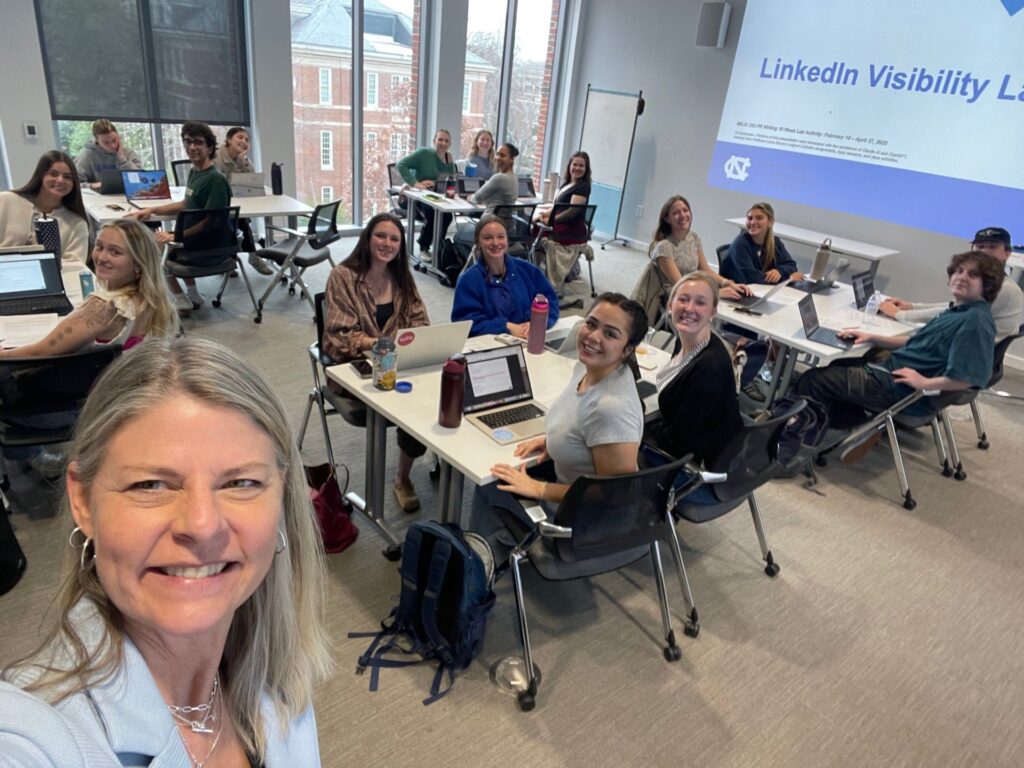
“I bring in the real world from day one,” Brown said. “Day one, we’re looking at industry audits, what companies are doing and how PR touches all elements of business. I always say purpose drives what you do. I challenge students to think about the needs of an organization, the challenges and how PR principles can be applied.”
Brown challenges students while signaling trust in their abilities, encouraging them to see their thinking as valuable and relevant. Her goal is for students to leave the classroom confident in their judgment and prepared to contribute meaningfully.
“Students come out of my class not just with technical skills, but with the ability to trust in themselves and their process of thinking,” Brown said. “They know their critical thinking abilities can add value and contributions that are as critical as work done at a senior level.”
She also emphasizes skills that students frequently underestimate, but employers notice immediately. Intellectual curiosity, confidence, initiative and an entrepreneurial mindset matter as much as technical proficiency. Brown encourages students to be solution-oriented, to identify opportunities rather than dwell on problems and to develop professional presence rooted in authenticity and respect for others.
Reframing networking
Networking, in Brown’s view, is not transactional. She teaches students to use platforms like LinkedIn as tools for learning, recognition and relationship-building, encouraging them to develop their professional brand, while also celebrating work done by others, seeking shared experiences and approaching connections with genuine curiosity.
“Networking isn’t about what you can get out of an interaction; it’s about developing a relationship and learning from each other,” Brown said. “Build personal connections by celebrating others in your industry and being curious about their work, while developing and sharing your individual perspectives along the way.”
Drawing on her own career, she stresses the importance of researching industries and organizations strategically, being open minded, cultivating networks at multiple levels and paying professional support forward.
“Build relationships with your classmates,” Brown said. “They are your peers now, but soon they will be your professional colleagues. Maintain the relationships you are making now, and look out for one another down the road.”
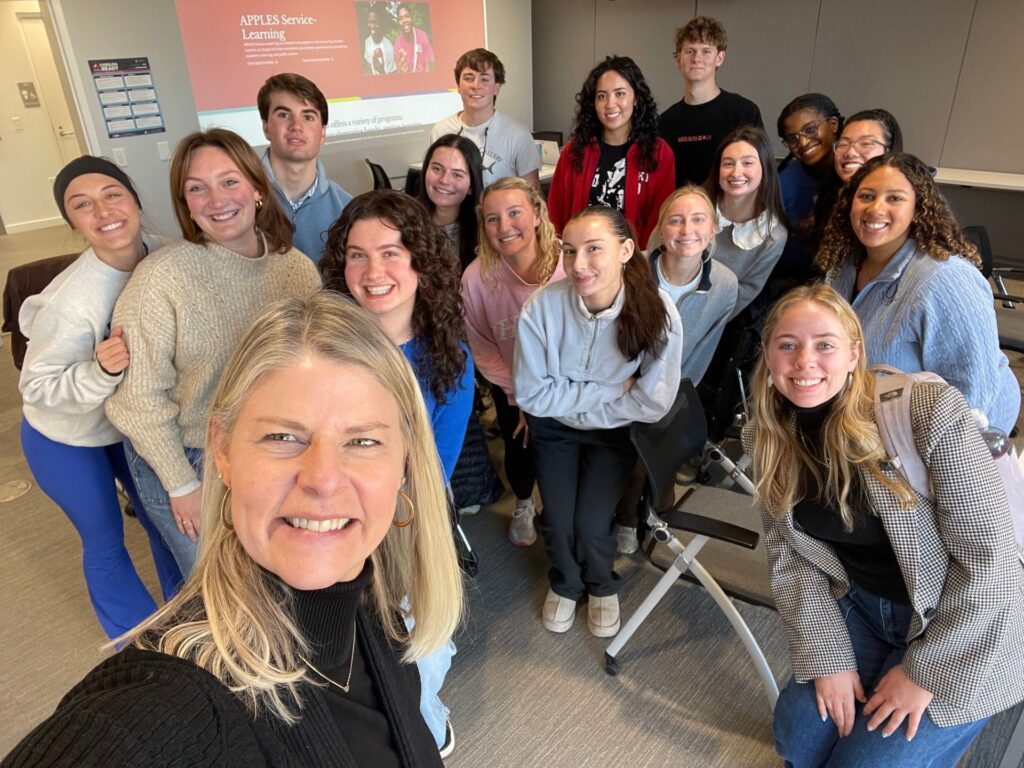
Brown’s agency background continues to shape how she teaches integrated campaigns and strategic communication. Remaining actively engaged in industry conversations allows her to bring current challenges, expectations and trends into coursework, helping students understand how classroom concepts translate into professional practice.
The future of communications
One of Brown’s primary areas of focus is the future of communication in the age of artificial intelligence. In her courses, she promotes guided and critical use of AI tools, emphasizing that while technology can support research, students remain responsible for original thinking and ethical decision-making. She frames AI not as something to fear but as a disruption that communicators evaluate thoughtfully, understanding both its risks and its potential to add value.
Brown’s work increasingly centers on AI governance, reputation management and the role communicators play in helping organizations assess emerging technologies responsibly. She prepares students to ask hard questions about transparency, trust and accountability as organizations adopt AI at rapid speed, positioning public relations as a strategic leader in managing these transitions.
Corporate social responsibility and civil engagement are also central to Brown’s teaching. She frames ethical communication as inseparable from business strategy, helping students examine how organizational decisions affect reputation, stakeholders and society at large. Through this lens, students explore sustainability, human rights and global interconnectedness, learning to view communications as a tool for positive change rather than mere promotion.
In an era marked by polarization and misinformation, Brown emphasizes mindful engagement over fear. She encourages students to clarify their values, understand multiple perspectives, develop cultural competencies, and navigate complexity without compromising empathy or integrity.
For Brown, public relations remains fundamentally about advocacy — educating, influencing and motivating in ways that contribute to inclusion, trust and the public good.
Looking ahead, Brown hopes students carry forward a sense of responsibility alongside professional confidence. She wants alumni to remember the importance of doing more good than harm, taking pride in their work and remaining intellectually curious throughout their careers. Above all, she hopes they remain resilient, open to change and committed to mentoring the next generation, just as others once did for them.


