News
UNC Hussman doctoral students earn top honors in Three Minute Thesis competition

This story, written by Ethan Quinn, was originally published at gradschool.unc.edu. Quinn is a student in the UNC Hussman M.A. in digital communication program.
Carolina graduate students spend years digging into complicated questions — from politics to children’s media to novel ways to treat chronic disease — resulting in dissertations that are hundreds of pages long and filled with academic jargon. At the Three Minute Thesis (3MT) competition, they had 180 seconds to explain all that work to a general audience.
The Three Minute Thesis is a professional development event hosted by The Graduate School in which graduate students distill their research into a clear, engaging talk that anyone can understand, all under a strict three-minute time limit. The format sharpens their public speaking skills while giving the audience a snapshot of the original work happening across campus.
The Graduate School’s annual 3MT is designed to sharpen public speaking and storytelling: finalists condense complex research into a clear, engaging talk that anyone can follow. Students say it’s practice for the moments they’ll face in their careers — a job interview, a conversation with a policymaker, a reporter looking for comment or a meeting with a potential funder.
Dean of The Graduate School Beth Mayer-Davis opened this year’s event by praising the finalists as “a great representation of the excellence of Carolina graduate student researchers spanning departments across campus,” and telling the audience: “You’re in for such a treat.” This year’s 10 finalists represented programs across six different schools and the College of Arts and Sciences, underscoring the range of graduate research at Carolina.
Finding the ‘three-minute version’ of complex research
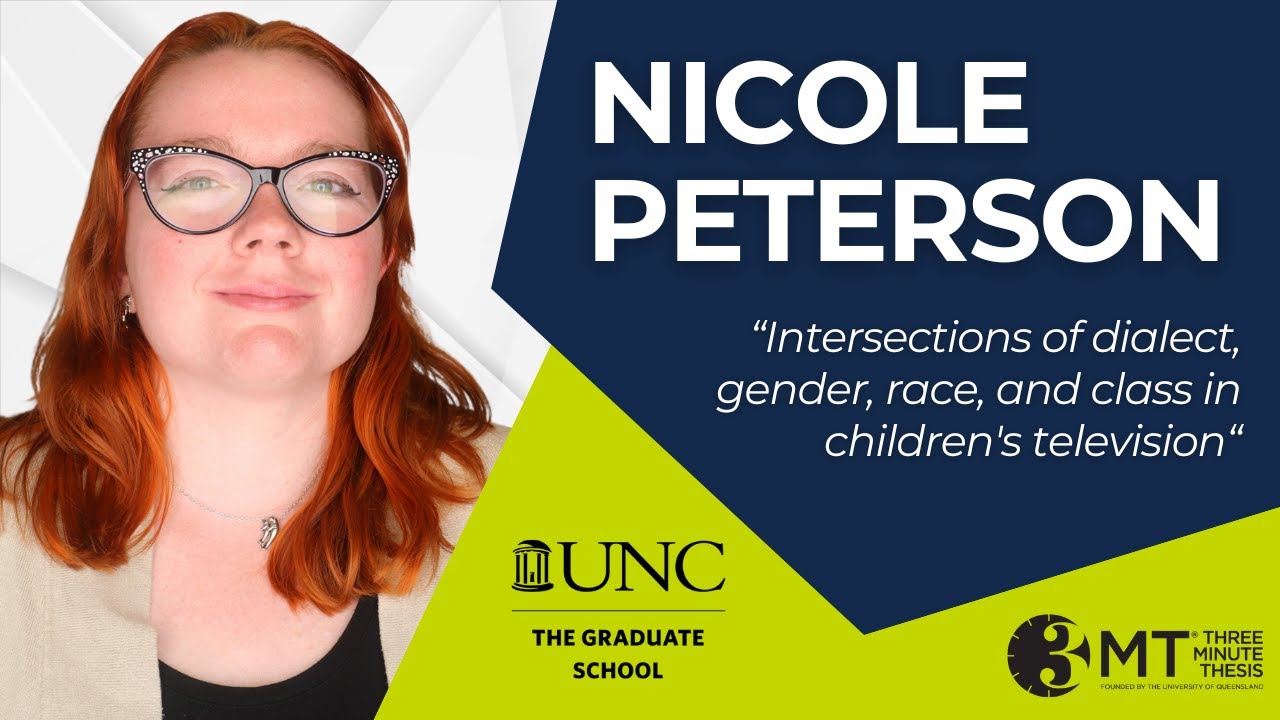
Nicole Peterson, a doctoral candidate in the UNC Hussman School of Journalism and Media, won the People’s Choice award for “Intersections of dialect, gender, race and class in children’s television.” Her research examines how children’s streaming shows portray different dialects — specifically Southern accents and African American Vernacular English — and how those portrayals can reinforce stereotypes or erase authentic voices.
“It forced me to create an elevator pitch,” Peterson said. “I’ve got 200 pages of research. I can’t present 200 pages of research in an interview, but I can get them to listen for three minutes.”
For Peterson, that kind of clarity isn’t optional; it’s critical to her career. “I think every student should do this,” she said. “Our most marketable skill is our ability to communicate. You’re going to have to talk to people. AI is not going to get rid of that.”
The market for certainty in politics
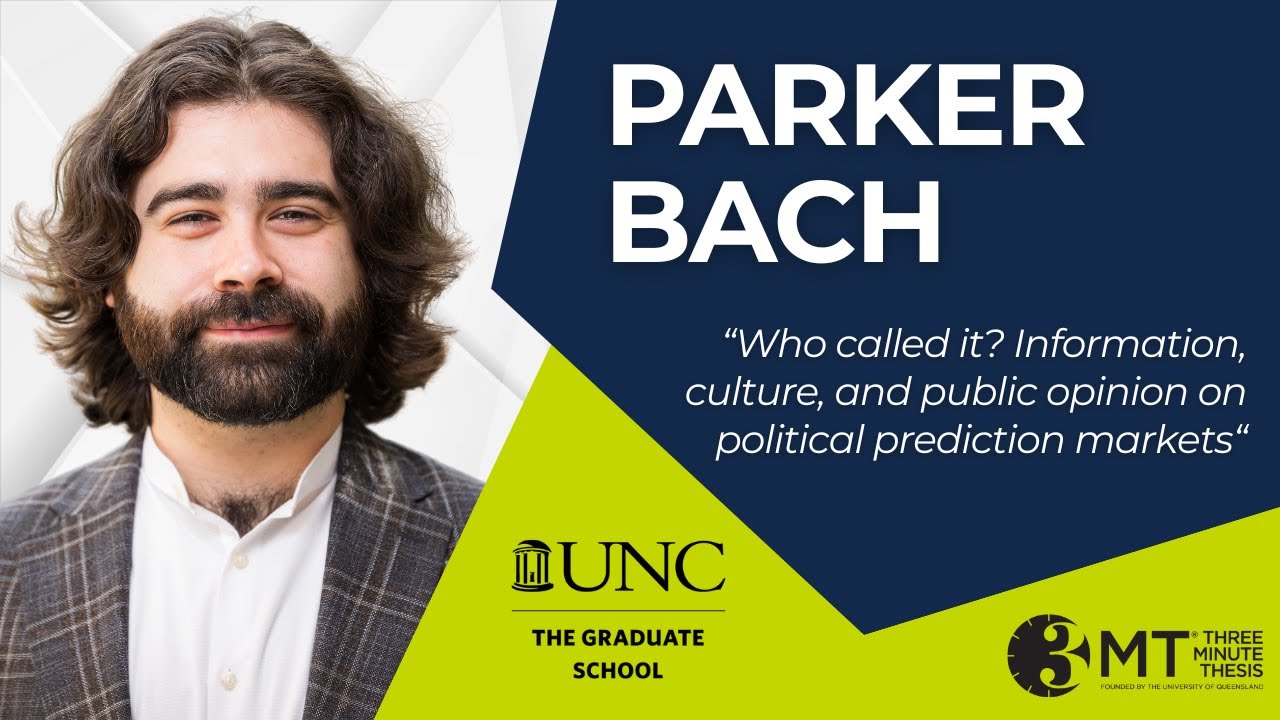
Parker Bach, a doctoral student also in the Hussman School of Journalism and Media, won second place for “Who called it? Information, culture and public opinion on political prediction markets.” His work examines prediction markets — platforms where people wager on future events — with a specific focus on election outcomes. “Journalists often treat the odds in prediction markets like they’re science, so I want to know how people decide to bet in them,” he said.
Bach said 3MT helped him get ready for conversations outside of academia. “This is a relatively new area of research, so I’ve also had journalists reaching out to me,” he said. “They’re obviously looking for a very concise and understandable explanation, and I feel like I have one ready to go now.”
He called the competition “a great chance to work on not only explaining what you’re doing to a general audience but also crystallizing for yourself why that’s important,” adding that public speaking is expected of academics but rarely taught directly.
‘Bugs as drugs’
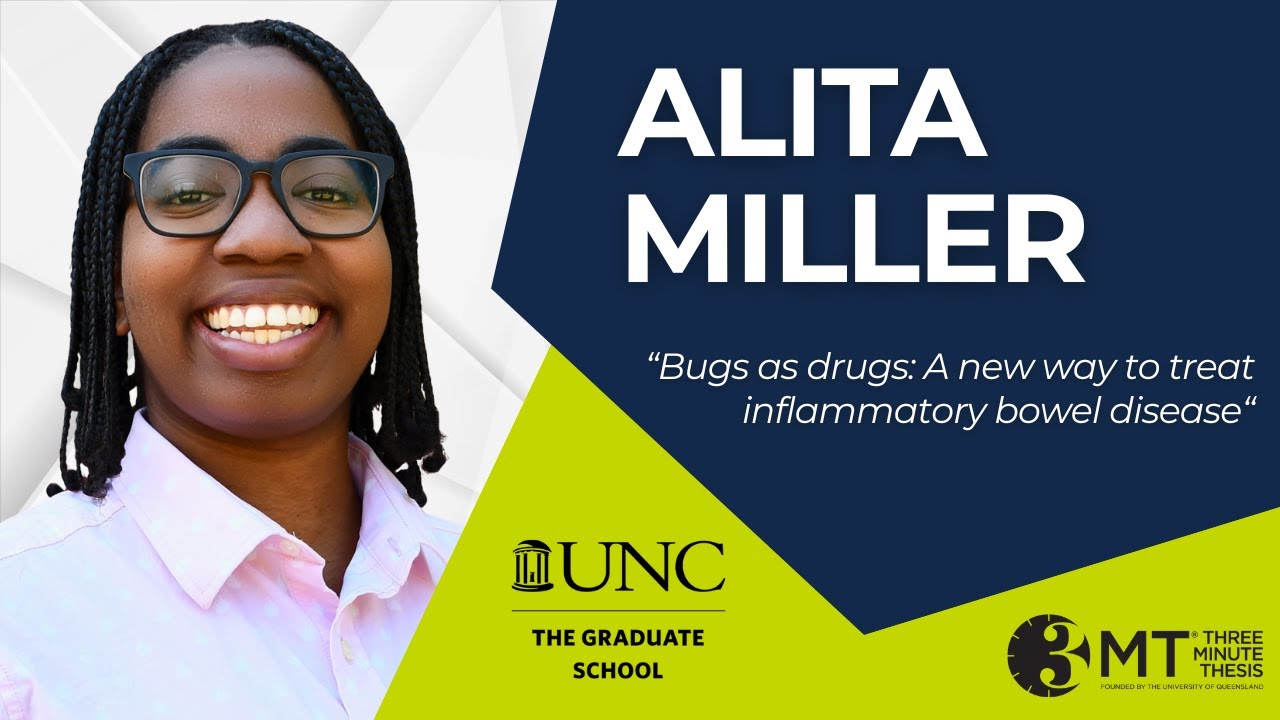
Alita Miller, a doctoral candidate in pharmaceutical sciences, won first place for “Bugs as drugs: A new way to treat inflammatory bowel disease.” As the overall winner, Miller will represent UNC-Chapel Hill at the regional 3MT competition, hosted by the Conference of Southern Graduate Schools.
Miller engineers probiotics — the “good bacteria” people often take for gut health — to move from general wellness supplements toward actively treating specific gastrointestinal diseases. She hopes to translate that research into real therapies and, eventually, into leadership in the biotech world. “One big aspect of leading teams or leading a company is being able to communicate in a very easy to understand way,” she said. “That’s what I learned through the 3MT experience.”
For Miller, 3MT wasn’t about memorizing a pitch. It was about making people care. The competition gave her a chance to practice explaining her research with energy and clarity in front of a live audience. It helped her not just make her work easy to understand but to frame it as a story about hope for people living with inflammatory bowel disease.
That response from the audience mattered. “It made me more driven to keep doing the work,” Miller said. “It was so encouraging that so many people now believe in the science and believe in me. I’ve already told five people that I think they should compete next year.”


