News
Don’t guess. Know! Putting students at the center of emergency preparedness

Knowing what to do in an emergency starts with being prepared.
This story was originally published on campussafety.unc.edu.
UNC-Chapel Hill Emergency Management and Planning is taking a new approach to safety training. Created by students for students, the new Don’t Guess. Know! Carolina Ready Student Emergency Preparedness Training helps students build the knowledge they need before they need it.
“Following the faculty and staff training, this training takes a different approach to emergency preparedness education,” says Justin Miller, EMP emergency management coordinator, “focusing not only on what students need to know but also how to communicate that information in a way that resonates with them.”
The project was developed through a collaboration between EMP and students in the UNC Hussman School of Journalism and Media. Before producing the training, UNC Hussman students conducted surveys and focus groups to better understand what their peers knew about emergency preparedness on campus.
The research revealed that students were sometimes guessing about how to respond to emergencies. That finding became the foundation for the training’s central message: Don’t Guess. Know!
Putting Students at the Center
Rather than assuming what students would find useful, the project began by asking them.
Through surveys and focus groups, the student research team explored where students get emergency information, which situations concern them most and how they perceive and respond to University emergency communications.
“My team was able to pinpoint specific areas in which pre-existing campus emergency preparedness could be improved, as well as where new ideas could be implemented,” explains Juliana McElerney, a senior advertising and public relations student.
The research also helped shape how the information would be presented.
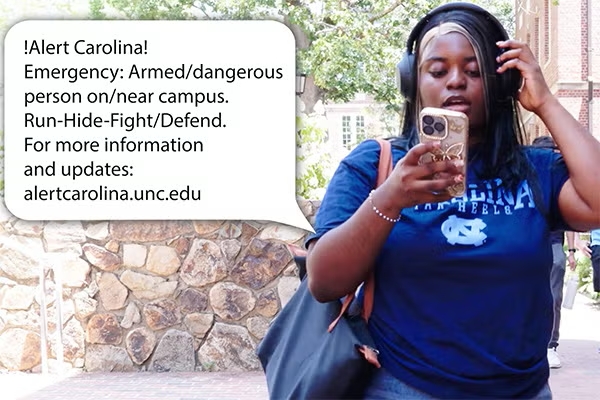
“Part of communication is understanding your audience and targeting your audience,” says Leyla Santiago, UNC Hussman professor of the practice who helped guide the project.
Students reviewed training materials Miller developed for faculty and staff as a foundation, while developing their own approach to the narrative and presentation. That included scenarios that reflect how students might encounter emergency information in their daily lives, rather than simply presenting preparedness information as a lecture.
The team also incorporated a question-and-answer segment designed to get students thinking about what they know and what they might be guessing about when it comes to emergency preparedness.
May Proctor, a senior journalism student, worked on the scripting, videography and editing elements, pulling the project together visually.
“I understand how students consume content and how attention spans are short, so we really made an effort to keep the videos short,” she says.
The project also gave UNC Hussman students the opportunity to work with EMP as a client and to experience the process of developing communications beyond the classroom. Students had to explain their creative decision, incorporate feedback and revise their work as the training took shape.
“[The experience] taught me a lot about communicating what your vision for the project is and how to mesh it with someone else’s vision,” explains Proctor. “I really enjoyed the real-world aspect of it.”
From Information to Action
Don’t Guess. Know! is available for students on Canvas with an Onyen login. Through practical preparedness tips and campus-specific guidance, students will learn how to stay informed, be prepared and confidently act if an emergency occurs.
“The collaboration gave us an opportunity to pair our emergency preparedness expertise with a communication strategy informed directly by the students we’re trying to reach,” says Miller.
For the students who helped create it, the project brought a personal perspective to the importance of being prepared for an emergency.
“I was two weeks into my freshman year [at UNC-Chapel Hill] when the [Aug. 28] campus shooting occurred, and I can still vividly remember how scared I and all of my classmates were during that time,” McElerney recalls. “This drove me to really dive deep into this research so that all of [the UNC-Chapel Hill] community will feel prepared in the face of an emergency.”
Video Production Team
- May Proctor: Media and Journalism (Journalism), Senior
- Jordan Houston: Media and Journalism (Journalism), Sophomore
- Elaine Jimenez: Double Major in Media and Journalism (Journalism),and Sociology, Class of 2026
- Cooper Molloy: Media and Journalism (Journalism), Junior
- Madelyn Hanes: Double Major in Sport Administration and Media and Journalism, Junior
- Rou Yu Tan: Double Major in Chemistry, Women’s and Gender Studies, Junior
Research Team
- Isabella Artiles: Media and Journalism (Advertising and Public Relations), Class of 2026
- McRae Lillie: Media and Journalism (Advertising and Public Relations), Junior
- Juliana McElerney: Media and Journalism (Public Relations), Senior
- Nicole De Zabala: Media and Journalism (Advertising and Public Relations), Class of 2026


